
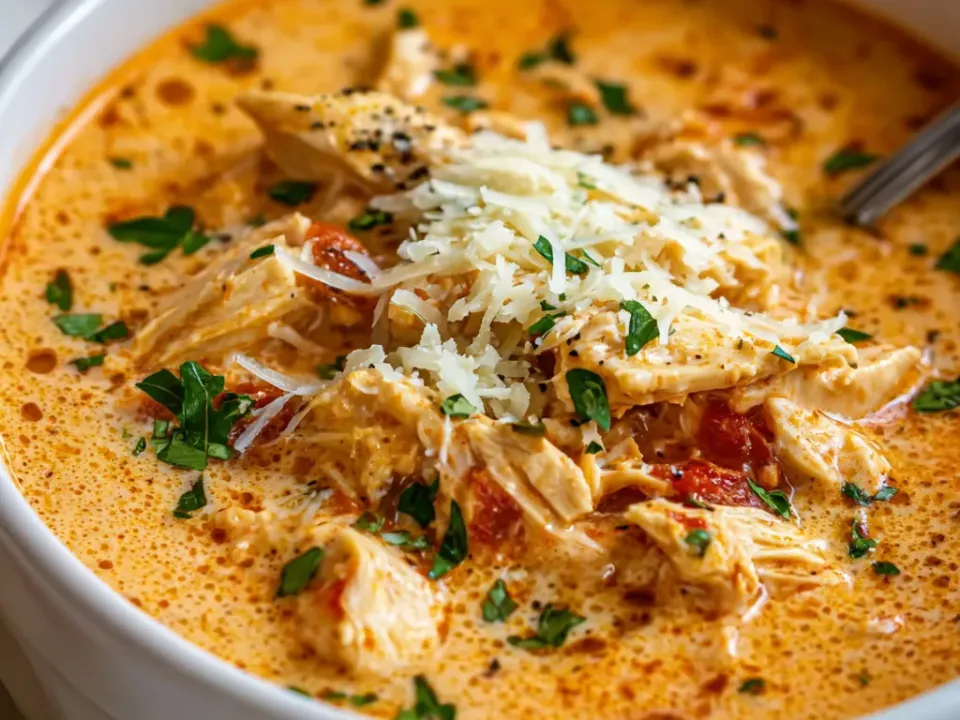
Chicken parmesan turned into a soup: chicken cooked in marinara all day, then enriched with cream cheese, cream and Parmesan and finished with small pasta and mozzarella.
Fifteen minutes of work, five to six hours on Low, and a few careful minutes at the end.
Why This Recipe Works
- Marinara plus a can of diced tomatoes gives two different tomato textures — a smooth base and pieces that hold up — which is what keeps the soup from tasting like thinned pasta sauce.
- Three cheeses do three jobs. Cream cheese thickens and emulsifies, Parmesan brings salt and savoury depth, mozzarella goes on top where it can stretch.
- Tempering the cream cheese is the step that makes this reliably smooth. Tomato is acidic and hot, and dairy added cold to hot acid is exactly the condition under which it curdles.
- Cream and Parmesan go in without boiling, which the method states plainly. Both split under a hard simmer and neither recovers.
The Pasta Question
Eight ounces of dry pasta is a lot of absorbent starch to introduce to four cups of broth. What you do with it decides whether this stays a soup.
Every soup with pasta in it faces the same choice: cook the pasta in the pot, or cook it separately? This recipe answers firmly — separately — and it is worth understanding why before deciding otherwise.
You follow the recipe as written
Cook the 8 oz of ditalini in salted water until al dente and add it to the bowls just before serving.
Pasta cooked in soup absorbs the soup. Eight ounces of dry pasta would take up a great deal of the four cups of broth and the marinara with it, and it keeps absorbing after the cooker is off — so the soup thickens on the table and again overnight. Cooked separately, it stays pasta and the soup stays soup.
You expect leftovers, which is likely at 8 servings
Keep the cooked pasta in a separate container and add it per bowl as you reheat.
This is the same reasoning taken one step further. Pasta stored in a cream-and-tomato soup overnight is bloated and soft by the next day, and it takes the soup's liquid with it.
You want it as a one-pot meal anyway
Add extra broth alongside the dry pasta and accept a thicker result.
It can be done, but it is a different dish - closer to a chunky pasta stew than the creamy soup this recipe is aiming at. Do not simply add dry pasta to the quantities as written.
Ingredient Notes
- Thawed chicken breasts
- A pound and a half. Thawed is the slow-cooker safety rule; breasts work here because five to six hours in a wet, acidic pot is gentler than a dry braise.
- Cream cheese, softened
- Four ounces, softened AND tempered. It is the thickener as well as the enrichment.
- Ditalini or small pasta
- Eight ounces, cooked separately. Small shapes suit a spoon; long strands do not belong here.
- Mozzarella
- One cup, on top rather than stirred in. Stirred through the pot it would simply disappear into strings.
How to Make It
Slow-cook the base
Combine the onion, garlic, marinara, broth, diced tomatoes, Italian seasoning, salt and pepper with the chicken breasts and cook on Low 5 to 6 hours, until the chicken reaches 165°F (74°C).
Shred
Shred the chicken and return it to the pot.
Cook the pasta separately
Cook the ditalini in salted water until al dente and drain.
Temper the cream cheese
Whisk a ladleful of the hot soup into the softened cream cheese, then stir the mixture into the pot.
Cream and Parmesan
Stir in the heavy cream and Parmesan without letting the soup boil.
Add the pasta
Add the cooked pasta just before serving.
Top
Finish the bowls with mozzarella and basil.
Success Tips
- Temper the cream cheese; never add it cold.
- Do not boil after the cream and Parmesan go in.
- Cook the pasta separately and add it per bowl.
- Check 165°F before shredding.
Serving Ideas
Garlic bread, which is the obvious partner and works. Basil on top if you have it, and more Parmesan at the table.
Storage and Reheating
Refrigerate
Refrigerate the soup up to 3 days with the pasta kept separate. Together, the pasta bloats and the soup loses its liquid to it.
Freeze
Freeze the soup without the pasta up to 2 months. Cream-based soups can separate slightly on thawing; a gentle reheat and a stir brings it back.
Reheat
Gently, below a boil, then add the pasta. High heat is what splits the cream and the Parmesan.
Frequently Asked Questions
My soup looked curdled after the cream cheese.
It went in cold, or straight into a boiling pot. Tomato is acidic and heat plus acid is the classic curdling condition — whisk a ladleful of hot soup into the softened cream cheese first, then add that mixture back.
Can I cook the pasta in the soup to save a pan?
Not with these quantities. Eight ounces of dry pasta would absorb a large share of the liquid and keep absorbing afterwards, turning the soup into a stew by the time it reached the table. Add extra broth if you insist, and expect a thicker dish.
Thighs instead of breasts?
They work and are more forgiving at the long end of the window. The soup comes out slightly richer from the extra fat, and the 165°F target does not change.