
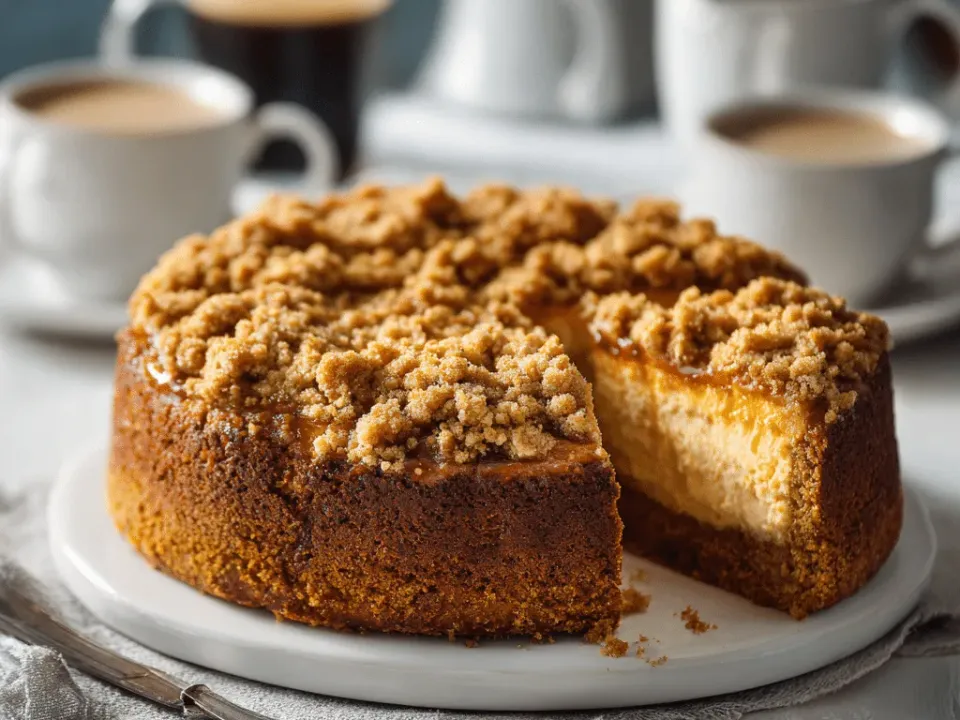
A pumpkin coffee cake with a sweetened cream cheese layer baked through the middle of it and a rubbed cinnamon streusel on top.
Twenty-five minutes of assembly, 45 to 50 minutes at 350°F, and half an hour of cooling before it will slice cleanly.
Why This Recipe Works
- The cream cheese layer carries an egg yolk. That single yolk is why it sets into a distinct pale band instead of melting into the crumb around it — the difference between a filled cake and a vaguely tangy one.
- Cold butter rubbed into flour and brown sugar makes crumbs that stay crumbs. Melted or softened butter would give you a paste that flows into a shell as it bakes.
- Two sugars in the cake do different jobs: brown for molasses depth and moisture, granulated for a lighter crumb. The recipe uses three-quarters of a cup of one and half a cup of the other rather than picking a side.
- Cinnamon appears three times in three different places — in the cake at a teaspoon and a half, in the streusel at half a teaspoon, and again as pumpkin pie spice. That layering is what stops it reading as one flat note.
- The tester goes into the CAKE portion, not the middle. A skewer through the cream cheese band comes out wet on a perfectly baked cake, which is how this style of bake gets overcooked.
What Is In The Pan, Bottom To Top
Step 7 loads the pan in a specific order and the order is the recipe. Read from the bottom of the tin upward.
The streusel
Flour, brown sugar, cinnamon and cold cubed butter rubbed to crumbs, sprinkled over the whole surface. It bakes into the lid rather than sitting on it.
The remaining pumpkin batter
Covered over the top. It will not spread as easily as the first half did — spoon it on in patches and nudge them together rather than dragging a spatula through and marbling the layer you just made.
The cream cheese mixture
Eight ounces beaten smooth with a quarter cup of sugar and one egg yolk, spooned over the batter. The yolk is what turns it from a spread into a layer that sets.
Half the pumpkin batter
Spread level across the base. This is the floor the cream cheese sits on, and it needs to be an even layer rather than a mound in the middle, or the band above it will slope.
Ingredient Notes
- Cream cheese, softened
- Eight ounces, and softened is not optional — cold cream cheese beats into lumps that stay lumps through the bake. Full-fat block rather than a tub, which is looser.
- One large egg yolk
- For the cream cheese layer only. It is the setting agent for that band; leave it out and the layer sinks into the batter as it warms.
- Cold unsalted butter, cubed
- Four tablespoons, for the streusel, and cold is the whole specification. Cube it and return it to the fridge if the kitchen is warm.
- Pumpkin puree
- One cup, plain puree rather than pie filling — pie filling is already sweetened and spiced, and this recipe sets both itself.
- Light brown sugar
- Packed, and used twice: three-quarters of a cup in the cake and a third of a cup in the streusel. Measure them separately rather than eyeballing one scoop.
How to Make It
Heat the oven and prepare the pan
Heat oven to 350°F. Grease and line a 9-inch square baking pan.
Whisk the dry ingredients
Whisk 2 cups flour, baking powder, baking soda, salt, 1 1/2 teaspoons cinnamon, and pumpkin pie spice.
Cream the butter and sugars
Beat softened butter, 3/4 cup brown sugar, and 1/2 cup granulated sugar until creamy. Beat in 2 eggs, pumpkin, and vanilla.
Fold the two together
Fold dry ingredients into the pumpkin mixture just until combined.
Make the cream cheese layer
Beat cream cheese with 1/4 cup granulated sugar and egg yolk until smooth.
Rub the streusel
Make streusel by rubbing together 1/2 cup flour, 1/3 cup brown sugar, 1/2 teaspoon cinnamon, and cold butter until crumbly.
Build the layers
Spread half the pumpkin batter in the pan, spoon the cream cheese mixture over it, then cover with remaining batter. Sprinkle with streusel.
Bake
Bake 45 to 50 minutes, until a tester inserted into the cake portion comes out without wet batter.
Cool before slicing
Cool at least 30 minutes before slicing.
Success Tips
- Level the first half of the batter properly; a sloping floor gives a sloping cream cheese band.
- Spoon the top layer on in patches and join them up rather than dragging a spatula across.
- Keep the streusel butter cold right up to the moment you rub it in.
- Test into the cake, not through the middle, or you will read the filling as raw batter.
- Give it the full thirty minutes before the first cut — the layer needs to firm to slice cleanly.
Serving Ideas
It is a coffee cake and it earns the name: squares alongside coffee, warm or at room temperature. Nothing needs to be added to it.
Storage and Reheating
Refrigerate
Cover and refrigerate up to 4 days. It contains a set cream cheese layer, so this one belongs in the fridge rather than under a dome on the counter.
Freeze
Freeze cut squares wrapped individually for up to 2 months. Thaw in the fridge overnight; the streusel softens but the layer holds.
Reheat
A few seconds in the microwave takes the fridge chill off a square. Longer than that and the cream cheese layer loosens.
Frequently Asked Questions
Does it have to be a 9-inch square pan?
That is the pan this recipe is written to and the only one its 45-to-50-minute bake time was set for. A different shape changes the depth of the batter and therefore the time, and no other time is published here.
Why did my cream cheese layer sink to the bottom?
Usually because the first half of the batter was not spread level, so the filling ran to the low corner. It can also happen if the egg yolk was left out — that yolk is what sets the band.
How is this different from the pumpkin cream cheese brownies?
They share cream cheese and pumpkin and nothing else. The brownies have a real chocolate base — melted bittersweet chocolate and cocoa — and their pumpkin mixture is swirled through rather than layered. This has no chocolate at all and its filling is a distinct baked band under a streusel lid.
My streusel melted into the top instead of staying crumbly.
The butter was too warm when it went in. Rub it in quickly with fingertips, stop while the mixture is still in loose crumbs, and chill the bowl for a few minutes if the crumbs start to clump into a dough.